|
| NO. 79 · NOVEMBER 22, 2026 |
|
|
In this issue
|
|
Eight Questions for Chris Merola
To help finance his first feature film, Chris Merola hand-delivered 100 letters to well-off strangers on Long Island. One of them invested. More very honest answers on making a feature below.
|
|
|
|
Now Streaming: The Bris
Isaac would do just about anything to marry the woman he loves. Her father has one very specific request. It’s streaming now, along with our 36-minute conversation with writer and star Omri Horowitz.
|
|
|
|
From the Notes
A few of our favorite new Notes, including one from a PREVO director who’s taken to leaving them under other filmmakers’ films.
|
|
|
|
The PREVO Ten, No. 13
This week’s No. 1 film didn’t just top the chart; it more than tripled No. 2. Plus, two films make the chart for the very first time.
|
|
|
|
Editor’s Note, or:
At least one thing we miss about DVDs
By Ryder McNeal
|
Do you, like me, mourn the mid-budget comedy of the 2000s? Think Superbad, Zoolander, Forgetting Sarah Marshall. Ever wonder where they all went, and why we hardly get them anymore? Allow me to explain. Back in the 2000s, before streaming, it was perfectly fine for a, say, $20 million comedy to bring in a respectable-but-not-eye-watering $40 million in theaters. Six months later, that same just-fine film would come out on DVD and rake in another healthy sum. That’s how so many of these films, which didn’t exactly smash the box office when they came out, became cultural icons that are still quoted endlessly. DVDs gave them a second, often longer, life. Then – lucky for us, unlucky for them – streaming came along and decimated the DVD market. So studios shifted their attention to films that could make more of their money in theaters. And where to look? International territories. I hope I’m not blowing anybody’s mind by telling you that an American high school comedy like Superbad doesn’t translate so well (linguistically or culturally). Zoolander made only about a quarter of its $60.8 million overseas. So studios leaned even harder into the dawning age of the superhero mega-hit and horror (scares translate well). And so, the mid-budget comedy died. Some would argue that the closest thing we have to them now is the horror film with a sense of humor. (Or Minions?) Regardless, I miss them, and two filmmakers we’re featuring this week are doing their part to bring them back: Omri Horowitz and Chris Merola. Omri is the writer and star of The Bris, a 13-minute comedy that premiered on PREVO this past Thursday and has been one of my most-anticipated premieres for some time. In last week’s issue, we asked Omri about his plans for the feature-length version (the short was actually adapted from the already-penned feature screenplay). And this week, PREVO co-founder Colt Waller and I sat down with him on camera to talk more about the short, the childhood spark that led him to acting, and his dream collaborators (hey, Seth Rogen, give us a call!). Watch it here. As for Chris Merola, he’s the director of a short comedy called The Doll, about two friends who receive a mysterious – and slightly ominous – sex doll in the mail. We’ve been trying to find a way to premiere it for a few months now, but I’m terrified of getting banned from the App Store (hey, Cupertino!). Chris is also the director of Lemonade Blessing, an independent feature-length comedy. (Note: feature-length!) Chris first got in touch in early September, the same week Projectionist premiered on PREVO. (If you’ve never seen it and won’t be near an IMAX for The Further Mis-Adventures of Cliff Booth when it opens Wednesday, it makes a very good 13-minute substitute.) Both Projectionist and Lemonade Blessing are released by the excellent Antenna Releasing (check them out here), and Chris reached out about premiering The Doll with us. While we haven’t been able to do that yet, with The Bris hitting the platform this week, now seemed like a good time to ask Chris how, exactly, he managed to pull off making a feature-length comedy. Below, you’ll find our full interview with him (a very well-placed bet on Tesla was involved). The rest of the issue has all the usual, including a few of our favorite new Notes and the PREVO Ten: the ten most-watched and most-talked-about films on PREVO from the week of November 9 – 15. That’s all for now, and Happy Thanksgiving. P.S. In some long-overdue news, The Weekend Read now has a proper home on PREVO itself (no more Substack!). You can now find every issue since No. 64 here and in the PREVO mobile app. |
|
Now Streaming New on PREVO this week One premiere · Thursday, November 19, 2026
|
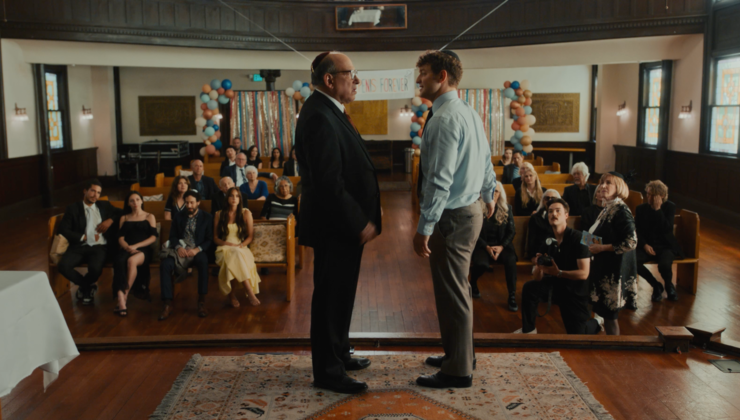 The Bris Written by and starring Omri Horowitz · Directed by Alec Bewkes · 13 minutes · Comedy To marry his Jewish girlfriend, Isaac reluctantly agrees to undergo an adult circumcision to win her father’s approval – only to discover what sacrifice and manhood really mean. Plus: Behind The Bris, our 36-minute conversation with Omri, is streaming now.
|
|
|
|
The Interview Eight questions for Chris Merola Conducted by email · November 2026
|
Chris Merola’s first feature, Lemonade Blessing, premiered in Tribeca’s U.S. Narrative Competition in June 2025 and has been on the road with Antenna Releasing since September. We sent him eight questions about paying for it, casting it, and the 15 months in between. His answers are below, lightly edited. |
 Chris Merola outside Pop’s Art Theater in Rochester, Minnesota, on the Lemonade Blessing roadshow. Photo courtesy of Chris Merola.
|
| 01 | You’ve talked about financing the film yourself at the start, with a well-timed Tesla bet and New Jersey’s film tax credit, before you brought in outside investors. What would you tell a first-time feature director who doesn’t have a Tesla windfall to start from? |
| | I wish I had an amazing money hack to share, but the truth is almost nobody gets six figures to make a film without some massive combination of luck and privilege. The only solace(?) I can share is that wacky sources of financing seem to be present at all levels. While on a round of generals, I found that many of the production companies I visited were funded by fine arts collectors, real estate moguls, dot-com bubble website developers. I recently discovered some indie films can get a shocking portion of their budget from wealthy donors in exchange for casting their relatives in supporting roles. For better or worse, nothing has changed since medieval times – we’re begging for patronage in any way we can. Between my foolish lucky investment and 15 other investors, I was able to put the film together. I went on Zillow and found high value homes on Long Island, wrote 100 letters, delivered them, I received one of the investments that way. For another, I wrote a horror feature outline for a commercial producer. If you’re born outside of the US, I’m sure soft money in the form of grants is possible to come by, if you’re willing and able to play that game well. For first time directors, I’d ask if they have a place to live rent free during and after production, how low their cost of living is – your own free labor over the course of several years can substitute for financing, if you can find a way to make the time. On Lemonade, I typed out all 1,669 closed captions myself (~$1000 saved), read a Clearance and Copyright tome so I could pre-conduct my own fair use analysis and submit it to lawyers to save a few billable hours (~$3000 saved) on our opinion letter in pursuit of E&O insurance, brought in my old videogame consoles and box art for production design and props (~$1000 saved), used my own hand for close-ups in the film to save on overtime for Jake (~$500 saved), you get the idea. Just be wary of burnout, it’s been two years since we wrapped and I’m still tired. |
|
| 02 | You cast Jake Ryan, whom plenty of people know from Eighth Grade and Asteroid City, and you’ve said you passed on actors with millions of followers between them. Why hold that line on a first feature, when a big following can help sell a movie? |
| | Every film has to make compromises – these can be creative, ethical, financial, or otherwise. In the case of Lemonade, I felt I had made the script as commercially structured as I was willing to go, and it was important to be uncompromising in some areas to balance things out. I can’t stand watching multimillion dollar “independent” films where the leads have no chemistry, and don’t feel right for their roles, because they were the only package that could get the film financed. There’s so much suffering involved in all of this, at a certain point it needs to be on behalf of something, or else why keep going? For me, this was a film about a time of life that’s deeply important to portray accurately, and I only wanted to cast people who were right for the role. I really believed in the meritocracy of art, that great performances in a good film win out over stardom. I still believe in that, but the time scale for the payoff is significantly longer than I could have initially anticipated, haha |
|
| 03 | The film swings between real tenderness and some truly profane comedy, sometimes within a single scene. How do you know when a joke about faith is landing, and when it’s just provocation? |
| | I tried to stay rooted in John’s POV, so that any sacrilege was being treated with the gravity that is present in his mind and heart. The thing is, so many people are either not religious or no longer identify so religiously, so the dissonance between the drama in John’s head and the reality of the situation often generates laughter. As long as we stayed truthful to his experience, I felt okay about whatever audience reactions came from that. |
|
| 04 | Lemonade Blessing premiered in Tribeca’s U.S. Narrative Competition in June 2025, played festivals in Germany, Poland, and Spain, and opened in theaters this September. What did those 15 months look like from the inside? |
| | A lot of hope, insecurity, joy, and anger. As my close friends can attest, I’m very much the incarnation of the “we’re cooked” to “we’re so back” chart. After I got management and started taking generals, my journals were filled with fantasies of the types of fancy groceries I’d buy once I came into the money that was most certainly coming. Then the next day I’d be despairing and furious that we didn’t have a single offer on the film, the next day I’d try to be in the moment and grateful over what it is I was experiencing. In Germany, at Mannheim-Heidelberg, we were in competition with all these deeply reserved arthouse films, I was sweating bullets of shame over my loud normie American movie. And then I felt bad for feeling bad at a festival where I was flown and housed and fed, god, it was an infinite spiral fueled by jet lag and self comparison. I think the hardest part about the whole experience was the widening disconnect between my internal and my external world. Before Lemonade, if I was feeling crabby it made some semblance of sense – I’m starting out, I haven’t made a feature, I still have so much to prove. But after Lemonade, so many people have texted, emailed, DM’d, approached me with some variation of “congratulations, you must be feeling awesome right now.” And it’s an incredibly dissonant feeling. On the one hand, I am very lucky in relative terms, on the other hand, the economics of our industry are so unspeakably dire that this broke 28-year-old who took a year to sell his film for zero dollars is somehow in an enviable position. It’s like living in a patriarchal cult where every wife is walloped with a frying pan thrice daily, and I’m a wife who only gets walloped once every two weeks or some shit, so I should be jubilant. The thing is, I know filmmakers in objectively better positions than me who more or less feel the exact same thing, so I’m sure a few people reading this are thinking the same thing I do when I hear those filmmakers complain – screw you, I’d kill to be in your position. And then you extrapolate this upwards, like, I’m sure major filmmakers with $10 million+ budgets get pissed when their latest features aren’t as financially or critically successful as their previous. At a certain point, you have to ask yourself whether your feelings are justified in light of your external reality. And I don’t really have an answer about how I ought to feel, I just know these last 15 months have been a wild journey internally, and I wouldn’t want to hide that reality from anyone. |
|
| 05 | This spring, the film became a Letterboxd Unreleased Gem, and then Antenna Releasing took it on. We had the pleasure of meeting Ryan Verrill this summer, and we’re big fans of what he and the team at Antenna are building. How did you and Antenna find each other? |
| | I was on Letterboxd’s Video Store as Stolen Kingdom was dropped onto the service. I reached out to some folks at Letterboxd for a screener since we had the prior relationship from Video Store. I really enjoyed the film, and researched Antenna. I found that Jeremy Long, Antenna’s Chief Talent Officer, was following me on Instagram, so I DMed him and asked if I could send along Lemonade. We all met soon afterwards and hit it off. |
|
| 06 | Since September, Antenna has been taking the film city by city, from Brooklyn to Los Angeles to Miami Beach, often with you in the room for the Q&A. Which crowd has surprised you most so far, and what happened? |
| | This is slightly unrelated, but right before our roadshow we were at a youth festival in Giffoni, Italy, and it was completely bonkers. Six hundred kids aged 15 to 17 watched Lemonade in a single screening, which on paper sounds great, until you think about how cringe the film is, and what it forces people to confront about their adolescence. These little f***ing Italians decimated us on Letterboxd, we went from a 3.7 to a 3.6 within five minutes of the credits rolling. It was amazing, shoutout to the motherland. As for the roadshow, the most surprising thing so far has been the depth of connection that’s arisen at each of the stops. I’ve had some screenings where I rolled into town a few days early and gotten to know local filmmakers, cinema owners, and employees. In places like Sidewalk Cinema in Birmingham, Alabama, or the Farmington Civic Theater in Michigan, or Guild Cinema in Albuquerque, New Mexico, I’ve walked away with these serendipitous conversations and friendships that make me feel seen and held and fed. The roadshow, it’s a lot of driving, empty motel rooms, cold open fields. The honest conversations with strangers turned friends are the touchstones I hold onto, everything else feels like a hazy in-between. |
|
| 07 | You described The Doll to us as a “wackadoo” short, and told us the doll itself cost $200. How did that one come together, and what does a short give you now that a feature can’t? |
| | My good friend (and editor of Lemonade Blessing and The Doll) Abhi and I are quite close, we frequently joke that if we were gay it would be over, we’d just get married because we’re so compatible and round each other out in so many ways. The idea for The Doll was for us to play fictional versions of ourselves and have this horrifically uncomfortable object externalize our unspoken attraction to one another – and force us to confront it, together. I was interested in seeing what remains when you take a small cadre of people from one project to another. For The Doll, we had a small crew composed of my DP, gaffer, editor, and composer from Lemonade, and it was really exhilarating to see what we could pull off with no money and some oddball determination. |
|
| 08 | What’s next for you, and where can our readers catch Lemonade Blessing in the coming months? |
| | We’ll be coming out to Los Angeles for a December 3rd screening at Brain Dead, then we’ll take a hiatus before coming back with a more traditional theatrical next March. Then we should be on digital by the end of April and physical media by next summer. I’ve got a few projects I’m actively pitching, with another I’m halfway through writing. I’ll probably catch my breath during the roadshow pause and figure out which one is most meaningful to pursue. |
|
|
Lemonade Blessing plays Brain Dead Studios in Los Angeles on December 3.
|
|
|
|
From the Notes
|
“The emotion of desperation is shown great here, and the reveal makes its meaning have continued depth.” |
|
“So well done. Loved the button on the end!” |
|
“Bloody and funny. I enjoyed this short film a lot.” |
|
“Inspired use of color here, talented team and direction.” Scott Barbella-Landy, director of 11:34 · on Door |
|
|
Leave a Note under any film on PREVO. It goes straight to the filmmaker, and every Note counts toward next week’s chart.
|
|
|
|
The Leaderboard The PREVO Ten, No. 13 Measured November 9 – 15, 2026
|
| 01 | Scratcher Dir. Tony Arriola, Steven Kiefer, and Mikkel Aranas · Back |
|
| 02 | Midnight Movie Club Dir. Alexander Beale · ▼ 1 |
|
| 03 | The Actor Dir. Alexander Hagani · ▼ 1 |
|
| 04 | Body Buddies Dir. Tommy Heffernan · New |
|
| 05 | Wight Dir. Jonathan Chen · Hold |
|
| 06 | DIY Dir. Tony Gardiner · ▼ 3 |
|
| 07 | Projectionist Dir. Pat McCoy and Nicolas Alexandre · Back |
|
| 08 | 11:34 Dir. Scott Barbella-Landy · New |
|
| 09 | My Kind of People Dir. Joe Picozzi · ▼ 1 |
|
| 10 | Phil Gunderson Teaches Screenwriting Dir. Nishanth Ramasubramanian · Back |
|
|
|
|
Not a member yet? Your ticket is on us. Use code TWRTICKET for a free first month of PREVO. That covers The Bris, our conversation with Omri, and everything else on PREVO. |
|
|
Free to submit, year-round, any genre. New premieres every Thursday.
|
|
PREVO Independent film, curated.
|
|